
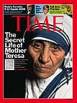
 The cover of this week’s Time Magazine features an article titled, The Secret Life of Mother Teresa. Why does a national magazine feature Mother Teresa 10 years after her death? According to the article a new book, Mother Teresa: Come Be My Light, brings to light correspondence that has not been widely read until now. These letters reveal a side of Mother Teresa’s spiritual life that will likely be surprising to many.
…in a letter to a spiritual confidant, the Rev. Michael van der Peet, that is only now being made public, she wrote with weary familiarity of a different Christ, an absent one. “Jesus has a very special love for you,” she assured Van der Peet. “[But] as for me, the silence and the emptiness is so great, that I look and do not see,–Listen and do not hear–the tongue moves [in prayer] but does not speak … I want you to pray for me–that I let Him have [a] free hand.”
According to the article, this “silence and emptiness” was not short-term, but lasted for years.
That absence seems to have started at almost precisely the time she began tending the poor and dying in Calcutta, and–except for a five-week break in 1959–never abated. Although perpetually cheery in public, the Teresa of the letters lived in a state of deep and abiding spiritual pain.
What to make of this? Perhaps we are initially shocked that one who was so dedicated to the cause of Christ could experience such a sense of His absence in her life. When we probe some more, what is more astonishing is that in spite of this sense of absence, Mother Teresa continued her complete discipleship to God in how she lived her life.
But perhaps we shouldn’t be so surprised at these things. The article rightly points out that a sense of God’s absence is an often normal part of the Christian life. In the 16th century John of the Cross called this absence the dark night of the soul. We can see this in the life of David when he writes in Psalm 21, “O my God, I cry out by day, but you do not answer, by night, and am not silent.” Jesus echoed David’s lament as he hung on the cross, “My God, my God, why have you forsaken me?” (Mathew 27:46)
Maybe Mother Teresa’s correspondence is not so much a shocking anomaly and more a window into the reality of faith. The truth is that this small, poor, seemingly insignificant woman continued to serve and give and love and pray despite her internal experience. That seems a revolutionary idea in a culture that has elevated the individual experience above all else.
I know that during times of Christ’s seeming absence in my life it has been the community of God that has reminded me that, despite what I currently feel, the presence of God remains with His people. And while most of us may not experience a dark night that lasted as long as Mother Teresa’s did, we can be sure that each of us will know what it means to wonder where God is. During those times maybe we could pray as she did, “that I let Him have [a] free hand.”
 David W. Swanson
Leave a comment