
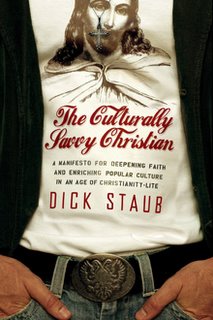
 This is my final look at Dick Staub’s new book, The Culturally Savvy Christian. You can find the first three parts here: one, two, and three.
In the last three chapters, Staub looks at the last section of his thesis, The culturally savvy Christin is serious about faith, savvy about faith and culture, and skilled in relating the two. So what does this skilled relating look like? Staub says that Christians of deep faith will often interact with pop culture as aliens and exiles. More specifically, Staub labels this interaction, “selective acculturation.”
As we follow Jesus’ example and engage with the world around us, we should not conform but should retain the distinctive beliefs, values, and behaviors that are consistent with God’s kingdom. The only only healthy way to live in the tension between the two worlds is selective acculturation; you often hear this described as being in the world but not of the world.
While there is a counter-cultural element to the culturally savvy Christian, Staub points out that there is also an ambassadorial role for us to play. We realize that there are often disconnects between life in our pop culture and life within God’s kingdom. A person of deep faith is invited,
to be a fearless adventurer and explorer, a relentless pursuer of truth wherever he or she might find it. Explorers approach unknown territories with all senses on high alert; only by entering will they know whether exciting possibilities, life-threatening dangers, or a mixture of both await them there. The skilled ambassador approaches popular culture in the same way, whether watching a movie, listening to music, reading a newspaper, or playing a game.
This thought seems to have huge implications for the church. First, I wonder how much of our culture we have neglected or abandoned because of our desire to remain separate. What might change if we began to see ourselves as adventures and explorers of God’s truth? Secondly, Staub sees all of our pop culture as submitted to Christ. It seems that, depending on our church culture, we may be prone to place more or less focus on certain aspects of our pop culture. As ambassadors we keep our eyes open to all of life, looking for “exciting possibilities or life-threatening dangers.”
Staub closes the book with a look at how we move from being solely observers of culture to “creating culture like artists.” There is a lot here that I won’t attempt to summarize. Ideally though, Staub sees the culturally savvy Christian as one who is much less a consumer than a creator. A convicting thought for me.
Overall I think this book offers a very balanced and nuanced approach to a Christians engagement with culture. There are few voices within the evangelical community that carry the wisdom and experience of Dick Staub. If any of this has piqued your interest I’d highly recommend you check out Staub’s blog as well as his Kindling’s Muse podcast.
 David W. Swanson
Leave a comment