
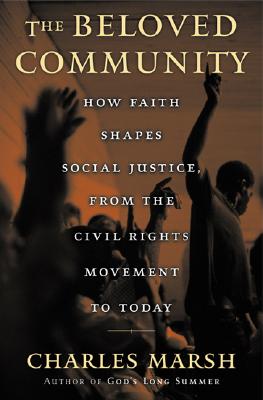
 There is a recent conversation within Evangelical circles that goes something like this: While it’s good for Christians to pursue justice we must be careful not to neglect evangelism. The cultures at large may applaud our involvement with justice but evangelism is the true Christian distinction. After reading The Beloved Community: How Faith Shapes Social Justice from the Civil Rights Movement to Today I’ve come to think this conversation represents an entirely lopsided understanding of justice, one that mostly neglects the history of social justice in America. According to Charles Marsh, it is the distinction of Christian faith that has defined movements of justice. The Beloved Community offers a compelling corrective to those who make too-clean divisions and hierarchies between the work of justice and evangelism.
If you’ve read Marsh, a professor at the University of Virginia, you’ve likely been amazed at the author’s ability to write history (footnotes and quotations abound) as an utterly captivating narrative. Chapters are arranged around a handful of women and men whose experiences during the Civil Rights Movement advance Marsh’s thesis, that it has been a robust Christian faith that inspires and sustains advocates for a more just American society. According to the author, when these movements wandered from their Christian roots they became unfocused, selfish and generally ineffective at bringing about systemic change. This is a strong stance, but Marsh argues it persuasively by piling up story upon story of farmers, preachers and students who were compelled to great sacrifice by their Christian hope, what Dr. King called “the great event of Calvary.”
The story Marsh tells is relatively unknown by many within majority culture churches, a major reason for the persistent conversations about the merits of evangelism over justice. As I read The Beloved Community– my favorite book of the past year- I found myself wishing more self-identified Evangelical pastors and churches were familiar with this history. The theology and practice of those Christ-centered men and women of past decades have so much to teach us today, including the fact that persistent work for justice is no more welcomed by society than is evangelism.
The Beloved Community tells both hopeful and discouraging stories within the larger history of social justice, but the book ends with recent examples of those compelled to join their justice-minded parents and grandparents in the Christian faith. Marsh makes clear that this history is still being written by those who take seriously their discipleship to Jesus. Hope, then, is the resounding note through the book and, despite the many set-backs and challenges, it is Christian hope that pushes the movement for justice forward even today.

 David W. Swanson
Leave a comment