
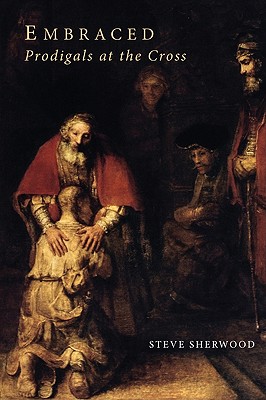
 For the past few days I’ve been interviewing Steve Sherwood over email about his new book, Embraced: Prodigals at the Cross. I’m posting part one here with the second part to come next week. I hope you’ll read Steve’s answers carefully because his is a perspective that isn’t often heard in the noisy debates about the atonement.
In the book you explore the center of Christian theology- the atonement-mostly through personal stories and metaphors. Was there a certain person, or type of person you had in mind when choosing this approach to the atonement?
I have spent 25 years in youth ministry with Young Life and, over the last 6 years have taught Bible Survey to freshmen at George Fox University. I had those two audiences largely in mind. Kind of a late teens/early twenties person with a little but not much familiarity with the biblical narrative. It was also a philosophical choice. I have been impacted by the statement I first read in Stanley Haurwas, “narrative precedes theology.” I wanted to try to DO theology narratively, believing that would give the theology more room to live and move on its own.
One of the primary ways you talk about sin throughout the book is in relational terms. How has your experience working with teenagers and young adults impacted how you explain sin?
Certainly, but I wouldn’t say that’s the primary factor. Working with young people I have seen sin played out in relational ways in their lives. In the choices they make and in the way they are wounded by the choices of others. I also think relational categories are the most biblical way to think about sin. In the Garden, Adam and Eve hide from one another, hide from God. Blame one another and soon their children become violent and envious. Those are all relational events. Additionally, the Old Testament Law, which is the basis for our forensic thinking about sin, comes AFTER the establishment of the Abramaic covenant which sets it in a relational context. I really believe sin is, first and foremost, a relational rupture before it’s a legal reality.
Would it be fair then to say that the penal substitutionary theory of the atonement is inadequate in its ability to describe God’s work through Christ’s death and resurrection?
I believe so, though I recognize that for some, to question the penal substitutionary theory, is to question the atonement itself. I believe God pays the price we owe, bears the weight of our shame, takes on the penalty or result of our sin. All the things at the heart of the penal approach, but I think they are ALL framed within a relational context first and that legal language in scripture only serves to round out a fundamentally relational concept. God tells two vivid stories in scripture to illustrate his work in the world. He tells Hosea to take a prostitute (or woman that will become one) as a wife “because your relationship will be like mine with Israel” and Jesus tells the story of the lost son. Both require sin/shame bearing by the innocent party to be restored to the guilty. Both require penalty. Both center around grace and both are relational from start to finish. Paul himself, the champion for penal theorists, describes God’s work in the world as “a ministry of RECONCILIATION” in 2 Corinthians 5.
I think one of the reasons we view penal substitution as THE means of atonement is that we read back into Paul’s language about the Law and the Old Testament itself our later western categories and conceptions of what words like “law”, “court”, “judge” or “guilt” mean. I would argue, along with NT Wright and others, that in doing so we lose sight of the essentially covenantal nature of those words in their original contexts. To question penal substitution’s adequacy to explain the atonement is not to question Paul or the Book of Romans, but to question our modern, Western read of him.

 David W. Swanson
Leave a comment