
does ignoring racism = ignoring the gospel?

I first saw this Barry Deutsch cartoon over at the Mustard Seed Associates blog.  [Click the cartoon for a larger version.]
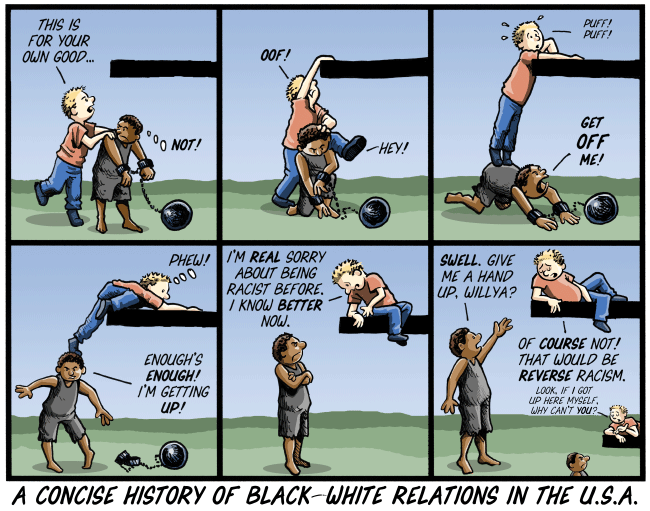
aconcisehistory

In the corresponding article, Tom Sine writes about the gulf between white privilege and the ethics of God’s coming Kingdom.

Usually, we are not aware that we benefit from white privilege and white power. We tend to view our lives and culture as “the norm.” To get ready for a new future and the in-breaking of God’s new order, we need to rigorously examine our dominant role in American culture and explore how it shapes our relationships with “minorities” and blocks our ability to be fully part of this new future.

In other words, benefiting from positions of privilege and power because of race or ethnicity is a significant barrier to participating in God’s mission in the world.  Racial disparity is not a passive accident of history, one that we white folks can sympathetically shrug our shoulders at.  When we ignore racism (both historic and current; individual and systemic) we are actually distancing ourselves from the type of reconciling work Christians are called to.  To ignore these realities and our role in them is to overlook the crucified and resurrected Christ who emptied Himself of power in order to enter into the depths of humanity’s suffering and slavery so that we might know grace and freedom.

Would you add any commentary to this? These are complicated and messy issues that, from my vantage point, have been overlooked or explained away far too often.

15 responses to “does ignoring racism = ignoring the gospel?”

  1. I mean, I completely understand the comic and the commentary, but I don’t know if I agree.

    I guess the question for me is when is everything “all good” again. Sincerely I mean that. It’s not a matter of not wanting to give back, or anything like that. If I am responsible for anything, I want to take care of that. My family history, etc…

    And I really don’t want to sound terrible here, because I honestly see NO difference between anyone of any color. We’re all God’s creation, all flawed, all requiring salvation. We all await a new creation, that is perfect, living with God in eternity… So, why treat anyone differently?

    So, this is not to say “I’m there, so I don’t need to do anything”, but eventually, I hope, everyone gets there, where it’s just not an issue anymore. And when we’re there, what should be done?

    I can definitely say that as a white person, I’m sincerely sorry for the legacy that’s been created by “my kind” (although I would completely disassociate myself from that legacy, because of the shame in it) but even saying “my kind” and “aligning myself” with a color sounds silly to me and very backwards. It’s not that I don’t want to offer olive branches. Of course I do. Of course I want things to be made right. But I don’t consider myself part of the problem. It seems odd, is all.

    I don’t know if I’ve been the recipient of white privilege. If I have, I’m sorry, but I would never desire it for myself or anyone.

    I guess it sounds silly to me to apologize for something I haven’t done. To me, the ultimate justice is for true equality to happen. And to me, anything else seems like politically correct dancing that takes us away from that dream.

  2. But to be clear, I am not saying “let’s ignore racism”. I do agree that to do that, ignores the gospel that we’re all in need, and that we all have opportunity to be reconciled with God. We have the opportunity to love everyone, as Christ commanded. It doesn’t matter what color I am or you are or anyone is. Racism gets in the way of this, and therefore is condemned.

    But I guess I disagree that I am somehow responsible for the privilege. or that this gets in the way of my ministry through Christ. If I’m loving people in the Lord’s name, and glorifying God, and loving him first, then how can it be possible that this is somehow lessened by some greater cultural spectre? The key is to change, not to linger. The key is to make things right, not simply apologize.

    I guess the best illustration of this could be stated as thus:

    To offer privilege based upon race (even if meant to “balance” some historic scale) is like an absentee, workaholic father taking the profits of his work and neglect and saying “here, I’m sorry I haven’t been there…I got you a pony.”

    It doesn’t mean anything. It’s just taking the spoils of the original bad effort and pretending that makes things better. Instead, if there was change, and the workplaces are truly equal-opportunity, and creditors were equal-opportunity, and on and on…THAT means something. That is actual effort to restore relations, rather than simply return one bad decision with another.

  3. I’ve been silent since reading your post yesterday because I don’t have a defense or even an offense for combating the injustices of this world except to try to understand how God would have me live my life in the circumstances and with the situations and in the relationships that are as present as He is. I want Him (even more than His message) to permeate, direct, drive me–even when I don’t know how to deal with the homeless, jobless, hurting people in my life–or the issues of race and privilege, our country’s poor choices at home and overseas, of life and death. I’m overwhelmed at global sized issues–but its in my daily life that I can see God, discover His ways and follow His example. Sometimes that leads to acting on global issues–those systemic ones that are so ugly. He calls me to prayer.

    As He asks us to pay attention to our world, as we read a comic like the one above, we can humble ourselves and ask the Holy Spirit to examine our hearts and show us what we can’t see ourselves and teach us how He would have us live. Because, ignoring sin and its legacy–ignoring hurting people–ignoring those God loves, is ignoring the Gospel.

  4. As always Otakudad, thanks for pushing the conversation. Much appreciated. You made two comments that stood out to me:

    I don’t know if I’ve been the recipient of white privilege. If I have, I’m sorry, but I would never desire it for myself or anyone.

    But I guess I disagree that I am somehow responsible for the privilege. or that this gets in the way of my ministry through Christ. If I’m loving people in the Lord’s name, and glorifying God, and loving him first, then how can it be possible that this is somehow lessened by some greater cultural spectre? The key is to change, not to linger. The key is to make things right, not simply apologize.

    I believe the point being made by the cartoon and by Tom Sine is that you are the “recipient of white privilege” whether you have actively sought that status or not. The history of our country is such that we white folks exist as insiders within the dominant culture; a cultural paradigm designed for and by white folks at the expense of those on the outside.

    Loving God and loving people is certainly the primary expression of the Christian faith. However, when white Christians ignore past and current racism can we say that our love is genuine? Acknowledging unjust structures and histories may not be lingering as much as it is understanding.

    I agree with you that the “key is to make things right, not simply apologize.” It seems to me that in order to make things right we must be willing to repeatedly look at what is wrong, not to be politically correct but to begin to understand the depths of the injustices and the complexities of the ways forward.

  5. Again, to pretend like nothing has happened in the past, or that we should simply say “Hey! Forgive and forget, okay?” Sure…that’s wrong, ignorant of a deep, historical cut, and definitely says “we don’t care about you” to the groups that were used as rungs on a ladder. Definitely.

    I agree that racism should not be ignored.

    But I guess the disagreement comes in the follow-up (I mean, after all, knowing this information does nothing. It’s choosing to act upon it, that defines us.) So, given that, I think that Tom Sine’s comments imply that we should tread softly, and that we should act differently towards African-Americans, because of the rift in the past. I disagree. I think that given the history of racism and pain, that the best way to proceed is to move towards an ever increasing equality where no man or woman is placed into a category by color. To forge that path with whatever privilege we have, in whatever position we find ourselves in, at whatever stage in life.

    But I think it’s condescending to treat someone with kid gloves simply because of their color, regardless of the past. To ignore it is wrong, certainly. But the lesson learned is that this behavior is terrible and despicable, not that we cannot be ourselves, or be competitive in the job market, or be whatever… There’s nothing wrong with switching things up and becoming servantile, because God commands that of everyone, to everyone. But I think that’s a reaction to God’s grace, not a color issue.

  6. I mostly agree with the cartoon and the commentary. I believe I am the recipient of white privilege at the expense of historical anti-black injustice and that legislation like affirmative action et al are appropriate steps to try to rectify this. (As an aside, we went to a black church while we were in Buffalo and heard nothing but the ‘personal responsibility side of this…which strikes me as appropriate for a black church but not for a suburban white church.)

    But I was wondering…how do these principles apply to immigrants? Let’s say a European (white) immigrant and an African (black) immigrant became citizens today…would the white man be in historical debt to the black man even though neither of their ancestors were involved? I don’t know the answer…but it seems like how one answerd this question would be symptomatic of how one saw the problem.

  7. Otakudad,

    I’ve never met you, but I get the feeling that we would get along quite well out in the real world. But your views on race relations leave me utterly confused. And I run out of words to describe how they make me feel. Not because you’re politically incorrect or stepping on people’s toes, per se. But because it seems like you’re trying to think out loud about race relations, but you’re running around in the same circular patterns.

    For instance, you say we (white people) should learn from our previous mistakes, yet you use an analogy of the white race as being a father to the black race. You say that we should treat each other equally, but you neglect the obvious example that African-Americans are placed (yes, placed) in an inferior place (as the cartoon so well demonstrates) and that equality and justice and fairness are things that we have to work on.

    Does any of this make sense? I’m not trying to guilt you, but when it comes to this topic, I do have to scratch my head a lot.

  8. Jas, I see what you’re saying. And perhaps I do have much to learn here. Because please, please understand, I’m NOT seeing any race as superior to another. And the father analogy is not taking “position” into consideration. The only parallel I’m trying to make is taking ill-gotten benefits and attempting to pass that off as real restitution for said ill-gotten gains. Likely, it was just a bad analogy. 🙂

    Because I am kind of mixed up here. I DO feel that there were wrongs that need to be addressed. Of course. To say otherwise is to utterly ignore the sad history of race relations in the U.S.. But my disagreement is in the implementation of the restitution.

    I don’t feel that granting the same inequalities, but in reverse makes things better. That may not seem “fair” but I don’t think fair is the issue. It’s fixing a systemic problem. Adding gasoline to the camp of the firestarter doesn’t balance things, it just burns more things.

    I just think that fixing the system towards something that truly is equal is what makes things better, not short-term, but always. Yes, this “balancing” is a short-term feel-good balancer, but then you still have the same problems, with a band-aid. I’d rather see lasting change that means something that can exist beyond the “leveling” than something we’ll have to change yet again, later whenever this wrong has been righted (and again, when does that happen?)

    Does that make sense?

  9. There is a good article in the weekend Wallstreet Journal called Why Foreign Aid Is Hurting Africa. The willingness to offer a hand to others isn’t the only issue but also how do you help without causing even more problems. I recall hearing a Chicago pastor talk about how the help offered by suburban churches can be a mixed blessing at times demeaning to those receiving it.
    I think the concept of white priviledge creates defensiveness by blaming and pointing fingers instead of looking at specific problems and then working towards solutions.
    For instance the Chicago Public Schools have a 45% drop out rate. I would think attacking this problem could have a dramatic effect on ending cycles of poverty. Why not follow the European example and have the funding for education follow the student instead of the school ? Remove the caps on charter schools in Illinois. Allow for school vouchers. Perhaps some competiton in the school system would help.
    Instead there seems to be a school monoply privildge at work. In Washington D.C. they are ending a voucher program that primarily serves minority students. In Missouri they have made it illegal to purchase old public schools and then use them as charter schools. I don’t get it.

  10. I am working with two African American sisters, age 10 and 13, in my small southern town as a mentor. It is a program that is offered through the school. I’ve been with them 4 years. Their parents appreciate that I am in their daughters’ lives. Their mom and stepdad are hard workers but the mom goes from job to job. I don’t know why the mom has so much trouble keeping a job. The mother is expecting her 8th child (with 4 different fathers and was 14 when she had her first). Their home is pitiful but adequate. They are on welfare and with that comes: rides to and from jobs; payment to the grandmother for babysitting; and free healthcare. Their oldest son (19) has just gone to St Louis for Job Corps which is a free education to all you want to take advantage of it. It can also mean free lodging, food and spending money, or so he tells me. Most times that I am in the grocery store, someone in line has a welfare card to charge their groceries on. I am glad we help, we need to help considering the past and the shameful ways we behaved as a nation and slavery, BUT there are many, many, many who have no idea of breaking free of the “you owe me” mentality. What do we do about that?

  11. Otakudad,

    I would guess that I’m in complete agreement with you. I would further guess that 90% of individuals who recognize that the system as-is is corrupt and racially unfair would also agree with you. Throwing money at a problem as big and deeply-entrenched as systemic racism will not solve anybody’s problem. So, did I miss something in the original article, or in the one that David linked to? I don’t recall anyone saying that you should be less-than-extraordinary when looking for work. Or that you should always watch your mouth around darker-skinned people.

    We are called to fight against, to struggle against the powers and principalities of the air, which at this juncture in history, use (sometimes slight) differences in skin color, in religion, in culture, in education, in mannerisms, in financial stability, etc, etc to drive wedges between people. And it seems that – to be honest – when some talk about making things right, when some talk about racial reconciliation, others only hear blame, or become defensive thinking that someone’s going to attack them or their family. And we all breathe this air. I know my black and brown students have. And so have I.

    But we need to be intelligent and mindful that we are acting/thinking/living in love. Which, I guess, means that we need to listen fully to those who have hurt and lost much.

    Sorry, bit of a rush. Again, don’t mean to sound judgmental. Sorry if I come across that way.

  12. Dan,

    I think you also bring up some good points, and they point to why we need to live incarnational lives. Instead, it seems to me that well-intentioned & well-off tend to think that giving money or doing this or spending a week pulling weeds or presenting the Gospel or something or other is the one true key to put the unfortunate or trampled or disenfranchised on the right path.

    But that didn’t seem to be God’s path. “He who knew no sin became sin on our behalf,” “He humbled himself to the point of death on a cross.”

    It seems to me like we always know the answer, yet we ignore the way of Jesus, living amongst the suffering; willing to go the extra mile with them; creatively and thoughtfully entering into their worlds, seeing as they do in all the myriad ways (b/c the “black community”, for instance, is not monolithic) and above all, listening.

    I truly think that’s what we’re missing.

  13. jane,

    Entitlement doesn’t just surround poor blacks, but also poor whites, poor Indians, etc. Hell, I think the worst, really, are uber-rich (mostly white) as we are seeing now. AIG, The Detroit Three, JPMorgan Chase, Bear Stearns, on and on and on. They all believe that they are somehow entitled to be treated well and that someone somewhere should pick up the bill for their behavior.

    But that is mostly a social-class issue. And blacks tend to be caught in that net largely because blacks are overwhelmingly poor. That net is not helping, surely. Yet, government is only filling a void.

    My advice? Not that you asked for it, but continue to do what you do and broaden the minds of those sisters.

  14. i’m sorry. was there anybody i neglected to trample over?

  15. Full disclosure: I love the cartoon. I think it’s an excellent illustration of the prevalent attitude of white Americans today.

    I want to touch on the issue of color blindness. Otakudad said that he sees no difference between people of different ethnicities. I feel that that is an incomplete answer. All people are created equal and are equally valuable in God’s eyes. I don’t think any argument to the contrary could be validly made from Scripture. But that doesn’t mean we are the same. God has created culture and ethnicity as a good thing, and the differences among us, when valued and learned from and utilized well, make our communities strong. When we stick with color-blindness, we are ignoring those differences, because we want everyone to be the same. If I operate under the assumption that we’re all the same, I will encounter and deal with people out of my mono-culturally white, bi-racial experience. That will typically work well with your average young, educated, white American. But what about older, less affluent black women? Or a young Asian man coming out a communal culture used to high respect for elders? The ways that I operate won’t work with them, and often will blow up in my face.

    There is no one right way to deal with anyone. I think that’s a hard thing for white folks (myself included) to deal with. We want to have our set rules of engagement and know that we can give everyone a fair shake. But it doesn’t work that way. I need to treat Asians and Asian-Americans differently than I treat African-Americans or Latinos. Doing anything less would be harmful to those relationships. Obviously, this requires a lot of work to be put in to our relationships. Cross-cultural friendships (deep, real relationships) cannot be done easily. If we are serious about healing the rifts that exist in this nation, we need to embrace the difficulty and pain that will come with the process.

    Whew,
    Anthony

Leave a reply to jas dye Cancel reply