
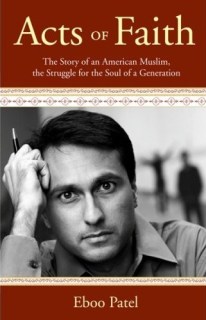
 I have tended to be unimpressed with anything bearing the “interfaith” label. My limited experience with dialogues and meetings between those of different religious traditions hasn’t been real impressive. Remaining unoffensive often seems to be the unstated point of these conversations. Additionally, the ecumenical tone is often condescending, as if those who affirm their religion’s particularities have yet to be enlightened as have the interfaith advocates. Thankfully this bland elitism is nowhere to be found in Eboo Patel’s memoir, Acts of Faith, about his experience with the interfaith movement, including founding the Chicago-based Interfaith Youth Core. In fact, by the end of the book I was ready to give the interfaith movement another chance.
Growing up in Chicago’s western suburbs as the child of Indian immigrants who practiced Ismaili Islam gave Patel a unique perspective on the role of religion in society. Acts of Faith documents his suburban childhood, college years at the University of Illinois, graduate school at Oxford, and a variety of adventures around the world. The common thread throughout these recollections is the search for identity as one who doesn’t fit the traditional American mold. American or Indian? Muslim by practice or culture? Scholar or activist? Cynic or optimist? Patel eventually came to claim his unique heritage along with the wisdom and experience from his varied and eclectic friendships.
As interesting as Patel’s story is, Acts of Faith is finally about something larger than any one person’s experience. The author believes that much of the religious violence in our day is due to the isolation and desperation experienced by young people around the world, of all religious traditions. He vividly describes how many terrorists are first recruited during their youth, when extremists take advantage of the desire to belong to a purposeful community. For Patel, the interfaith conversation isn’t about lowest common denominator committee meetings with a lot of talk and no action but a movement that offers an alternative to violence and death.
Acts of Faith is that rare book that instructs and inspires while telling a page-turning story. But what I most appreciated is where Patel’s story took him. Today he strongly advocates for interfaith conversation and service while simultaneously pushing for distinction among faiths. In other words, in order for a conversation to go somewhere, the participants have to actually believe what they are talking about regardless of whether they can agree on everything. According to Patel, the most effective co-laborers in the movement to counter religious extremists and terrorism are those of different faiths who know where they disagree and yet find shared conviction from which to work for the common good.
I recommend Acts of Faith to you whether or not the interfaith movement is of interest. In a time of continued polarity and separation, often by religion, Eboo Patel’s story is a genuine sign of life.


 David W. Swanson
Leave a reply to faith on campus video contest « signs of life Cancel reply