
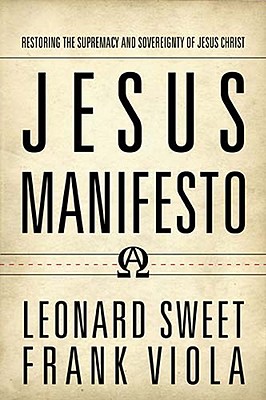
Jesus Manifesto

On this blog it’s my practice to only review those books I can wholeheartedly recommend.  For this reason Jesus Manifesto: Restoring the Supremacy and Sovereignty of Jesus Christ presents a small dilemma.

While much of the content in this offering from Leonard Sweet and Frank Viola is outstanding, the organization and editing of the book leave a bit to be desired.  The authors say they wrote “this book in an ancient devotional tone.”  Perhaps this accounts for its areas of disjointedness and context-less illustrations.  More than once I wondered whether a more vigorous editor could have pulled together a tighter and more focused trajectory from the authors’ significant intentions.

Even so, I would still recommend this book to many of you.  Sweet and Viola set out to bring the reader’s “vision and understanding of Jesus Christ into sharper focus.  We hope to present our Lord to you in such a way that you cannot help but love Him.”  This they do very well.  While plenty of Christian books purport to be about Jesus, here is a book that actually is all about Jesus.

But don’t pick up Jesus Manifesto expecting much in the “how-to” category.  In many ways the book reminded me of those old paperbacks on my bookshelf by A.W. Tozer, writing that is more about showing than telling.  In this case the authors commit to showing us as much about Jesus from the Scriptures as possible in less than two hundred pages.  (I really wish the publisher would have included an index of the many, many Scripture references included in the book.  This would have significantly broadened it’s usefulness for the preacher and teacher.)

Sweet and Viola are concerned that Jesus is no longer the center of Christianity in much of the American church.  I share their opinion that too often Jesus is relegated to the sidelines in favor of other moral, political, and theological agendas.  The priority in our day and every day is to repeatedly demonstrate the supremacy of Jesus Christ over any other agenda.  In this respect, Jesus Manifesto is a helpful poke to the chest of an often-distracted church.

3 responses to “Jesus Manifesto”

  1. In the evangelical Christian circles I have been a part of, I hear way more about the Son (Jesus) than either the Father (in second place) or the Spirit (in third). So while Jesus may “no longer be the center of Christianity in much of the American church,” he is named far more than the other persons in the Godhead!

    1. I had similar thoughts while reading this book. Seems like there is always another book that claims to refocus our attention on the forgotten member of the Trinity.

  2. Thanks, Dave, for the recommendation. It sounds like a very worthy effort.

    The heart and goal of Orthodox Christianity is this vision of God. It is central to the Orthodox Christian understanding of the meaning of our Christian life that is is only when we attain to the pure vision of God (when we “see Him as He is” as the Apostle John puts it 1 Jn 1:19) through a life of prayer, faith and an ever deepening repentance that we can be transformed into Christ’s likeness and thus fulfill our calling as beings made in the image of God. Hence the importance of the “Holy Icons” so prominent in Orthodox worship to aid in the development of a capacity for that vision. Even the reading of Scripture within this context is viewed by the Orthodox as a “verbal Icon” of Christ. If the Scriptures do not provide for us this ever clearer vision of Christ, we are not reading them aright and they profit us nothing. I am reminded of Christ’s words: “And I, when I am lifted up, will draw all men to myself.” I think it was St. John of Damascas in the eighth century, defender of the Holy Icons during the Iconoclast controversy in the Church, who coined the expression: “Icons do with color what the Scriptures do with words.”

    With regard to Andrew’s comment above and your response, as an Orthodox Christian I would say a proper vision of Christ is impossible apart from a proper vision of both the Father and the Holy Spirit. Approach to Trinitarian doctrine is perhaps one of the most fundamental dogmatic markers of schism between Eastern Orthodoxy and the whole of Western Christendom (with the historic unilateral introduction and addition by a Roman Pope of the “filioque” clause in what was up to that point the universally accepted form of the Creed defining orthodox Christian faith). Since all prayer is made within the Orthodox Church always “in the Name of the Father, and the Son, and the Holy Spirit,” there is a more consistent emphasis within Orthodoxy on the “threeness,” the Persons, of the Trinity. Consequently, there has never been a movement to “rediscover” one or other of the Trinity’s Members historically in the Orthodox Church as has tended to happen from time to time in the West.

    With regard to Trinitarian doctrine, Orthodox Priest and blogger, Fr. Stephen Freeman recently observed that for most Christians in western church traditions, it would make little difference to their actual practices and approach to the Christian life if God were viewed in a strictly monotheistic way as is typical within Judaism and Islam. But if that were to happen within Orthodoxy it would destroy the very foundation of our whole Faith. I wonder if this resonates at all with you? It seems to ring true to me as a former Evangelical.

Leave a reply to David Swanson Cancel reply