
I read a few books in 2011 and, as in past years (2007, 2008, 2009, 2010), I have somewhat haphazardly chosen five favorites. How about you? What books most impacted how you think and live this year?
——————–
The Pastor, Eugene Peterson.
 In recent years Eugene Peterson has become, entirely through his many books, one of my pastoral mentors and guides. Reading Peterson is to first encounter a contrarian voice only to slowly realize how thoroughly the voice has been shaped by the Bible. If Peterson sounds like a prophet from an earlier era it is surely a sign of how deeply the scriptures have penetrated is mind. In this book, his memoirs, we watch as the young man from the pentecostal family in Montana comes to start and pastor a Presbyterian church in suburban Baltimore. While many know Peterson for The Message, a popular translation of the Bible, The Pastor sticks to the two decades of pastoring his congregation. Over and over again he shows, and occasionally expounds, the fruit of a life spent simmering in the Bible. As a church planter myself, I was especially impressed to watch the young Peterson reject the proven methods of the church growth movement, choosing instead to walk faithfully with a slowly growing community that was discovering its Christ-formed and Biblically-imagined identity. I’ve recommended this book more than any other this year.
——————–
The Seven Storey Mountain, Thomas Merton.
 I’d seen Thomas Merton’s autobiography in our neighborhood used book store a few times before finally bringing it home. I’m glad I did. Written in 1948, Merton describes a time, culture, and spirituality that all feel vaguely familiar and just out of reach. Two things stand out in my memory. First is the simultaneously mundane and dramatic nature of Merton’s conversion to Catholicism. In his telling we see a parade of moments where the mystical interrupts the young man’s steps, only to be brushed back by his pursuit of pleasure and intellectual stimulation. And then, abruptly, a conversion that completely reorients his life. I wonder if this isn’t the convert’s typical route. Second is Merton’s willingness to see his own sin woven into the fabric of a world bent on its own destruction. His conversion and entry into a monastery are told with World War Two’s shadowy approach as the backdrop and the new Christian knowingly claims his part in the oncoming evil. Despite his occasional jab at Protestants – funny when he’s exaggerating; uncomfortable when he’s not – this was the book I least wanted to end this year.
——————–
Malcolm X: A Life of Reinvention, Manning Marable.
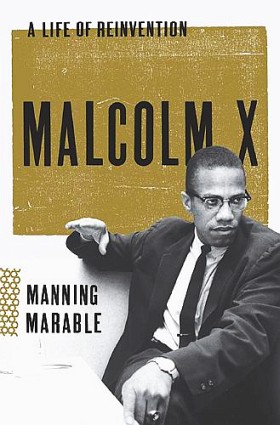 What many of us know about Malcolm X comes from the excellent Spike Lee film starring Denzel Washington. The film in turn drew heavily from Malcolm’s autobiography, compiled and edited by Alex Haley. Manning Marable’s Malcolm X: A Life of Reinvention dramatically adds to and, at times, alters, our perception of the Muslim minister and activist. Marable, a professor at Columbia who tragically died as the book went to press, spent years pouring over documents including previously unreleased FBI surveillance. He interviewed many who knew Malcolm, including an unprecedented nine hour interview with Minister Louis Farrakhan, the Nation of Islam leader. The result of his thorough research is an incredibly engaging narrative that both humanizes an icon while revealing again why this man mattered and continues to matter.
——————–
The Gift of Good Land, Wendell Berry.
 How does a collection of essays about agriculture published in 1989 maintain its poignancy? Berry – a poet, farmer, novelist, and essayist – is a master wordsmith but it’s his observations about the way America works, and doesn’t, that remain completely relevant. The author cares about language, especially what our choice of metaphors says about our shared priorities. He laments the loss of agricultural and biological words; the mechanical and industrial (and, I would add, technological) language we now favor leads to exploitative attitudes towards land and people. Berry’s insight about language and how it impacts our practices has significant resonance within Christian community. I have an article coming out next month with our denomination’s magazine where I make the case for setting aside mechanical, industrial, and technological metaphors to describe our churches. The Bible, as Berry notes in some of these essays, provides living metaphors for the people of God. Despite the foreign-ness of this language for many of us, making the effort to reclaim it will lead to new priorities, ones which nurture the generally slow process of spiritual growth.
——————–
Paul Among the People, Sarah Ruden.
 Sarah Ruden is a Classical scholar and translator who has written a surprising book about the apostle Paul, author of most of the New Testament books. Pulling from her significant expertise with the language and nuances of Greco-Roman culture, she attempts to place Paul within a culture very different from our own. Does it sound boring? Ruden’s writing style reveals a light hand and playful spirit, neither which take away from aha! moments on almost each page. By placing Paul among his Greek and Roman contemporaries Ruden shows how humane the apostle’s Christianity was within a violent and often oppressive world. Her chapters on women – Paul: An Apostolic Oinker? – and homosexuality – No Monsters. No Closets – made me squirm with vivid descriptions of exploitation. Within this context, the Gospel Paul received and passed on sounds like the best possible news.


 David W. Swanson
Leave a reply to Michael Cancel reply