
Friend and blogger Jason Dye think Wall*E ought to be considered for the Best Picture award by the Academy, rather than the Animated Feature Film award it is in contention for. He makes a good case.
It seems that the only type of genre that the Academy respects is drama. That is too bad. However, I think it’s also rather odd that a group of professional movie-makers seems to think that the medium (actually, media) of animation is a sort of genre itself. And I suppose that argument could also be made for feature-length documentaries (some of the most phenomenal movies made in the last twenty years are docs) and foreign language films, but those people have their own films to sell you on, I’ve got this one: Wall*E.
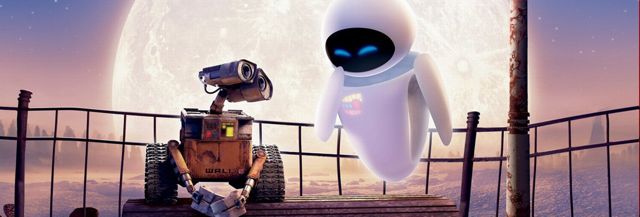
Wall*E is a story of a solitary but optimistic robot left with the futile task of cleaning up the Earth’s garbage long after humans have left the planet as a huge, inhabitable dumping ground (in fact, the only other creature on the planet from our perspective is a cockroach that acts as his sidekick). Wall*E’s loneliness is interrupted by a high-tech scout robot named Eve. The ever-playful Wall*E – a true hopeless romantic and hapless put-upon in the tradition of the Silent-era greats Buster Keaton and Charlie Chapman – fawns over and tries to woo Eve. The ever-secretive Eve begins to lay her guard down due to the powerful effect of his charm, openness and the fact that he makes her laugh (single men, take note). Alas, Eve suddenly turns silent and awaits the return of her shuttle after discovering a plant that Wall*E’s been holding in his salvage pad. We later learn that this is her primary objective, to scope out the planet for signs of life (Hmmm…) to bring back to her ship, the Axiom – which holds the descendants of those who abandoned Earth seven hundred years earlier.
Critics of the film tend to say that once the movie leaves Earth and heads off into the reaches of space (when Wall*E tags along with the shuttle) it loses steam and identity – or even worse, it becomes a preachy film. Rather, I suggest, the theme sharpens in exploration and with tension. It is on the Axiom that Wall*E discovers a world full of people who have lost their moorings, who have no True North, who are adrift at sea in virtually every possible manner. It is through Wall*E’s spirit of kindness and his identity rooted in love and resulting self-sacrifice that others are gathered around him. If his cause moves from a futile And it is through his identity, purpose and actions that they begin to renew their cause and their identity. In fact, the one villain of the movie is the one machine that cannot see past its old objective to a new, relevant, and meaningful one. Everyone else essentially adopt the Captain’s protest, “I don’t want to survive; I want to live.”
As per the technical stuff, this being a Pixar movie, and helmed by Finding Nemo‘s director Andrew Stanton, it almost goes without saying that the film is breathtakingly beautiful and a wonder to look at. I feel like a child looking at a whole new world most times I enter a Pixar presentation. Initially I was disappointed in the feature’s brevity (98 mins.), but upon subsequent viewings, I found its economy to be refreshing, allowing me – like some of my favorite albums – a chance to draw from the well time and again without subsequent exhaustion. And, as with all great comedy – and, for that matter, drama – timing is everything and the timing here seems appropriate, if not slowed down during bits. It’s too bad it didn’t come out at a time when it would have been appreciated by a more open-minded Academy of Motion Picture Arts and Sciences.


 David W. Swanson
Leave a reply to Keith Cancel reply